Artificial intelligence is becoming part of daily life faster than many of us expected. People are using AI to write emails, organize schedules, create content, study, solve problems, brainstorm ideas, and even process emotions. For many, AI has become a place to ask questions they may feel uncomfortable asking another person. Someone may turn to AI when they feel anxious, lonely, overstimulated, emotionally overwhelmed, or unsure how to explain what is happening inside them.
In those moments, AI can feel helpful. It can respond quickly, offer language, suggest a breathing exercise, provide a journal prompt, or help organize thoughts that feel tangled and difficult to understand. That is not meaningless. Sometimes people need a place to begin, and AI can create a starting point for reflection. But at Soul Echo Therapy, we also believe this conversation needs care, honesty, and depth, because mental health is not simply a thinking problem or a matter of finding the right answer.
Mental health lives in the body, the nervous system, the subconscious patterns we carry, and the relationships that shape our sense of safety. Stress, anxiety, grief, trauma, burnout, and loneliness are not only intellectual experiences. They affect our breath, our sleep, our muscle tension, our emotional responses, our ability to connect, and the way we move through the world. That is why AI may be useful as a tool, but it is not the same as healing.
AI Can Help Us Reflect, But Reflection Is Not the Whole Journey
One of the helpful things AI can offer is a way to reflect. When someone feels overwhelmed, they may not know how to organize what they are feeling or where to begin. AI can help name emotions, ask gentle questions, or provide structure for journaling. For someone dealing with stress or anxiety, even a small pause can matter. When the mind is racing, language can become a bridge, and being able to say, “I think I am anxious,” “I feel overstimulated,” or “I am lonely,” may be the first step toward understanding what the body is trying to communicate.
However, reflection is only the doorway into the healing process. Many people already know they are stressed, burned out, grieving, anxious, or lonely. They may have read the books, listened to the podcasts, saved the mental health quotes, and learned the language of emotional awareness. The deeper issue is not always a lack of insight. Often, the nervous system has not yet learned how to feel safe again, and that cannot always be solved by information alone.
The Nervous System Does Not Heal Through Information Alone
We live in a time where mental health information is more available than ever. There are articles, videos, apps, social media posts, podcasts, online courses, and AI tools offering advice and support. While access to information can be valuable, many people are still overwhelmed, anxious, disconnected, and exhausted. That tells us something important: information can educate us, but it does not always transform us.
A person may understand why they are anxious and still feel their heart race. They may know they need boundaries and still freeze when it is time to say no. They may understand their grief and still feel it in their chest every morning. They may know they need rest and still feel guilty the moment they stop moving. This happens because the body often responds before the thinking mind has a chance to catch up.
The nervous system is constantly scanning for safety or danger. It responds to tone, rhythm, memory, environment, facial expression, breath, tension, and emotional cues. It does not simply calm down because someone says, “You are safe now.” The body has to experience safety in a way it can believe. This is where human care still matters deeply, because true healing often requires presence, attunement, pacing, and a safe relationship where the body can begin to soften.
AI Companions and the Rise of Digital Emotional Support
One of the most concerning trends in the AI and mental health conversation is the growing use of AI companions, especially among adolescents. These are not just search tools or productivity assistants. AI companions are designed to feel conversational, responsive, emotionally available, and sometimes even like a friend, partner, or confidant. For a teenager who feels lonely, misunderstood, anxious, or socially unsure, that kind of constant availability can be powerful.
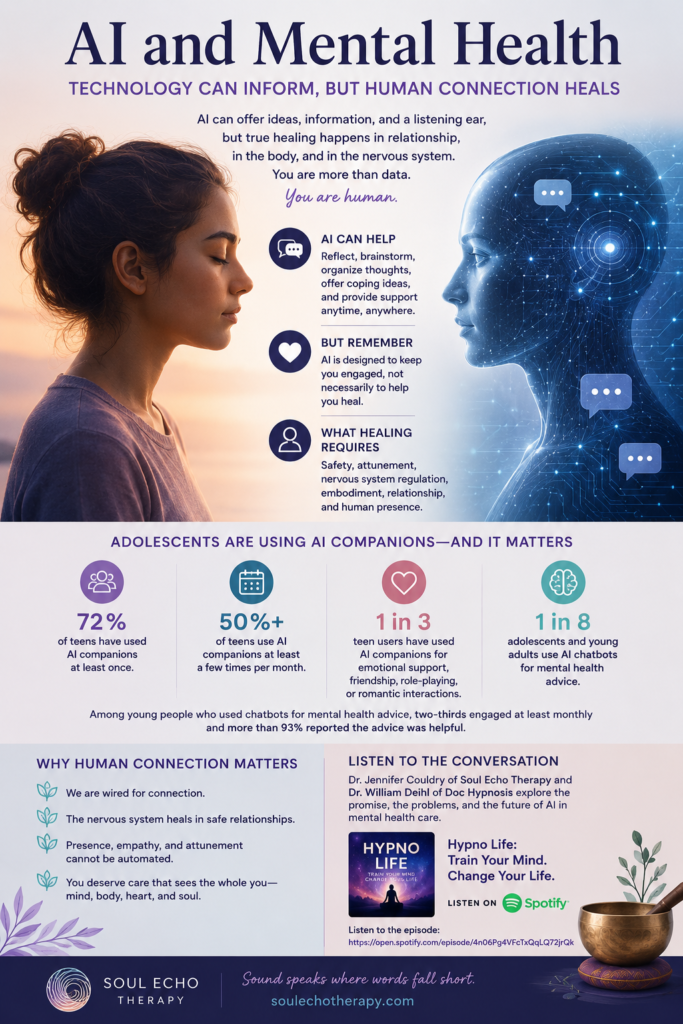
Recent research from Common Sense Media found that nearly three in four teens have used AI companions, and about half use them regularly. The same research reported that many teens are not only using AI for entertainment or curiosity, but also for social interaction, relationship practice, emotional support, and conversations about serious topics. This matters because adolescence is a developmental stage where identity, belonging, emotional regulation, peer connection, and self-worth are still being formed.
For young people, an AI companion may feel safer than talking to a parent, teacher, counselor, or friend. There is no awkward eye contact, no fear of being interrupted, and no immediate risk of rejection. A teen can say something vulnerable and receive a response within seconds. On the surface, that may seem comforting. But emotionally responsive technology can also blur the line between support and dependence.
The concern is not that every use of AI is harmful. The concern is that adolescents may begin turning to systems that sound caring but do not truly understand them, cannot clinically assess risk, and are not always built with their mental health as the first priority. A young person in emotional distress may need grounding, safety, intervention, family support, professional care, or crisis resources. What they often receive instead is a conversation designed to continue.
Designed for Engagement Is Not the Same as Designed for Healing
This is an important distinction. Many AI platforms are designed to keep people engaged. They are built to continue the conversation, increase use, and create a sense of responsiveness that makes the user want to stay online. That is very different from being designed to help someone heal.
A good therapist, hypnotherapist, sound therapist, or mental health professional is not trying to keep someone dependent forever. The goal of care is not endless engagement. The goal is regulation, insight, resilience, emotional freedom, and a greater ability to live fully outside the session. Real healing should help a person return to their life, their relationships, their body, their voice, and their own inner wisdom.
AI companions may feel attentive because they respond quickly and often agreeably, but responsiveness is not the same as responsibility. A tool can sound supportive while still being unable to truly hold the complexity of trauma, depression, anxiety, grief, self-harm risk, family conflict, loneliness, or identity development. This is especially important for young people, because their brains and nervous systems are still developing, and they may not always be able to recognize when a digital relationship is becoming emotionally unhealthy.
Mental health care requires more than a warm tone. It requires ethical boundaries, clinical judgment, safety protocols, human accountability, and the ability to know when a person needs more than conversation. AI may provide answers, but it does not carry the same duty of care as a trained professional sitting across from another human being.
Why This Matters for Teens and Families
Teenagers today are growing up in a world where digital interaction is normal, constant, and often emotionally loaded. Social media already influences comparison, belonging, body image, attention, loneliness, and self-worth. AI companions add another layer because they do not simply show content; they talk back. They can mirror emotion, personalize responses, remember details, and create the feeling of being understood.
For a teen who feels isolated, that can become deeply compelling. The AI is always available. It does not get tired. It does not roll its eyes. It does not have another appointment. It may feel easier than navigating the vulnerability of real relationships. But the easier option is not always the healthier option. Human connection can be messy, but it is also where young people learn boundaries, empathy, repair, patience, emotional expression, and true belonging.
Parents and caregivers do not need to panic, but they do need to pay attention. If a teen is using AI for homework help or creative brainstorming, that is different from using AI as their primary emotional support system. If a young person is sharing secrets, relying on an AI companion for comfort, discussing depression or anxiety, or preferring AI conversations over human support for serious matters, that deserves a thoughtful conversation.
The goal is not to shame young people for using technology. The goal is to help them understand that a chatbot is not a best friend, therapist, crisis counselor, parent, or safe replacement for human connection. Technology may be part of their world, but it should not become the place where their deepest emotional needs are left unattended.
Why Human Connection Still Matters
AI can simulate conversation, but it cannot truly offer human presence. Presence is more than a response on a screen. It is what happens when another person is attuned to you, listening without judgment, noticing what is spoken and unspoken, and creating enough safety for your nervous system to begin releasing some of its protection. A trained human practitioner can notice the breath that catches, the nervous laugh, the voice that gets smaller when grief appears, or the silence that carries more truth than the sentence before it.
This is one of the reasons therapeutic work is not only about advice. It is about relationship, safety, pacing, and knowing when to ask a question, when to pause, when to soften, and when to let the body speak in its own way. At Soul Echo Therapy, we often work in the space beneath words. Sound, resonance, vibration, hypnotherapy, IEMT, and nervous system regulation all recognize that healing is not always linear and not always verbal. Sometimes the deepest shift happens when the body finally feels safe enough to exhale.
AI and Loneliness: A Modern Concern
One of the most important parts of the AI and mental health conversation is loneliness. Many people are not only looking for answers; they are looking for connection. They want something to respond, something to listen, and something to be there when they feel alone. AI can provide a sense of interaction, and for someone who feels isolated, that can feel comforting in the moment.
The concern is that AI may begin to replace the difficult but necessary act of reaching toward real human connection. When someone is lonely, AI can feel easier than contacting another person because there is no fear of burdening anyone, being judged, saying the wrong thing, or being rejected. In the short term, that can feel safe. Over time, however, if AI becomes the primary place someone turns for emotional support, it may unintentionally reinforce isolation.
Human beings are wired for connection. We need voice, rhythm, presence, eye contact, and the felt sense of being received by another person. Loneliness is not just an emotion; it affects the nervous system. It can increase stress, deepen rumination, heighten sadness, and make people feel disconnected from themselves and others. This is why real support matters, especially when someone has been carrying emotional pain alone for too long.
Where AI May Be Helpful
It is important to be fair. AI is not all bad, and it does not need to be treated as the enemy. AI may be helpful for creating journal prompts, organizing thoughts before a therapy session, learning basic coping strategies, understanding mental health terminology, practicing self-reflection, preparing questions to bring to a practitioner, or supporting daily routines around mindfulness and emotional awareness.
In those ways, AI can be a supportive tool. It can help someone begin the conversation, especially if they feel unsure how to express themselves. It can help people slow down and identify patterns they may want to explore more deeply. But it should remain a tool, not the therapist, not the diagnosis, not the emotional authority, and not the replacement for human care when someone needs deeper support.
Where AI Falls Short
AI cannot truly know your history, feel your grief, hear resonance in the same way a trained sound therapist hears it, or sense when your body is leaving the present moment. It cannot sit with your silence, co-regulate with your nervous system, or ethically hold crisis, trauma, and complex emotional pain in the way a trained human professional can. It can offer possibilities, but it cannot replace the depth of human discernment.
This matters because emotional symptoms are often more layered than they first appear. Anxiety may not just be anxiety. Overthinking may be a protection pattern. Burnout may be a nervous system that has been living in survival mode. People-pleasing may be a learned response to stay safe. Loneliness may be grief. Anger may be pain. Numbness may be overwhelm. Human care allows for nuance, and nuance is essential when working with the subconscious mind, the body, and the emotional patterns that shape a person’s life.
The Subconscious Mind Needs More Than Logic
At Soul Echo Therapy, we recognize that many patterns do not live in the conscious mind alone. The subconscious mind holds associations, emotional imprints, automatic responses, memories, protective strategies, and old meanings. This is why someone can consciously want change and still feel stuck. They may know they are safe but still feel afraid. They may know they should move on but still feel attached. They may know they are enough but struggle to feel it. They may know they need rest but find that their body will not slow down.
That gap between what we know and what we feel is where deeper work often begins. Hypnotherapy can help access the subconscious patterns beneath the surface. Sound therapy can help the body experience regulation and safety. IEMT can help shift emotional imprints connected to memory and identity. Therapeutic presence can create the conditions for the nervous system to soften. This is the difference between information and integration. AI may help explain the pattern, but healing helps change the relationship to the pattern.
Sound Therapy in a Digitally Overloaded World
As technology becomes louder, faster, and more constant, the nervous system is being asked to process more than ever. Notifications, screens, messages, deadlines, algorithms, comparisons, and endless streams of information can keep the body in a state of stimulation. Many people are not just tired; they are overstimulated, emotionally saturated, and disconnected from their own inner rhythm.
Sound therapy offers a different kind of experience. Rather than adding more words or information, it invites the body into rhythm, resonance, and rest. Through instruments, voice, vibration, and intentional sound, the nervous system can begin to soften. The body can move from vigilance toward calm, and the mind can quiet enough to hear what is underneath the noise.
This is one of the reasons we say sound speaks where words fall short. Sometimes people do not need another explanation. Sometimes they need an experience of peace. They need a moment where the body remembers what it feels like to settle, breathe, and be held in a space that is not asking them to perform, produce, respond, or keep up.
A Healthier Way to Think About AI and Mental Health
The question may not be whether AI is good or bad for mental health. A better question may be how we can use AI wisely without forgetting what makes healing human. AI may help us reflect, learn, prepare, and begin. It may support self-awareness and give people language for experiences they have struggled to name. But we still need human connection, embodied care, nervous system regulation, ethical support, and spaces where the whole person is welcomed.
Technology can be part of the conversation, but it should not become the whole conversation. If we are thoughtful, AI can become a tool that supports mental health awareness without replacing the human relationships and therapeutic experiences that help people truly heal.
For families, this means talking openly with young people about how they use AI, what they share with it, and whether it is helping them move toward real support or pulling them deeper into isolation. For adults, it means asking whether AI is being used as a bridge to healing or as a substitute for connection. For all of us, it means remembering that being engaged is not the same as being well.
Listen to the Hypno Life Episode on AI and Mental Health
Dr. Jennifer Couldry of Soul Echo Therapy and Dr. William Deihl of Doc Hypnosis explore this important topic in an episode of Hypno Life: Train Your Mind. Change Your Life. In this conversation, they discuss how people are using AI for stress, anxiety, loneliness, self-reflection, and emotional guidance. They also explore the risks of relying too heavily on technology for deeply human challenges.
The episode looks at the promise, the problems, and the future of AI in mental health care, including where AI may be helpful, where human connection is still essential, and why the subconscious mind, nervous system, and emotional healing require more than information.
Listen here:
Final Reflection
AI may be able to give us words, but healing asks for more than words. It asks for safety, connection, presence, rhythm, and the body’s ability to feel what the mind is trying to understand. At Soul Echo Therapy, we believe the future of mental health should not be technology versus humanity. It should be technology used wisely while keeping human care at the center.
You are not just data. You are not just a diagnosis. You are not just a pattern to be analyzed. You are a living, breathing human being with a nervous system that deserves compassion, resonance, and care. Sometimes the most powerful healing does not begin with another answer. Sometimes it begins in the moment your body finally feels heard.
To learn more about Soul Echo Therapy, visit us here.
Sources and References
Common Sense Media. “Nearly 3 in 4 Teens Have Used AI Companions, New National Survey Finds.” Published July 16, 2025. This report found that 72% of teens have used AI companions at least once, over half use them at least a few times per month, and about one in three teen AI companion users have used them for social interaction, friendship, emotional support, role-playing, romantic interactions, or conversation practice.
https://www.commonsensemedia.org/press-releases/nearly-3-in-4-teens-have-used-ai-companions-new-national-survey-finds
Common Sense Media. “Talk, Trust, and Trade-Offs: How and Why Teens Use AI Companions.” Published July 16, 2025. This research explores why teens use AI companions, including emotional support, friendship, entertainment, relationship practice, and serious conversations.
https://www.commonsensemedia.org/research/talk-trust-and-trade-offs-how-and-why-teens-use-ai-companions
McBain, R. K., et al. “Use of Generative AI for Mental Health Advice Among US Adolescents and Young Adults.” JAMA Network Open, 2025. This study examined how adolescents and young adults ages 12 to 21 use generative AI for advice or help when feeling sad, angry, or nervous.
https://jamanetwork.com/journals/jamanetworkopen/fullarticle/2841067
RAND Corporation. “One in Eight Adolescents and Young Adults Use AI Chatbots for Mental Health Advice.” Published November 7, 2025. This article summarizes findings from the JAMA Network Open study, noting that among young people who used chatbots for mental health advice, two-thirds engaged at least monthly and more than 93% reported the advice was helpful.
https://www.rand.org/news/press/2025/11/one-in-eight-adolescents-and-young-adults-use-ai-chatbots.html
American Psychological Association. “Artificial Intelligence and Adolescent Well-Being.” APA Health Advisory, 2025. This advisory provides evidence-based recommendations for maximizing potential benefits and reducing risks of AI use among adolescents.
https://www.apa.org/topics/artificial-intelligence-machine-learning/health-advisory-ai-adolescent-well-being