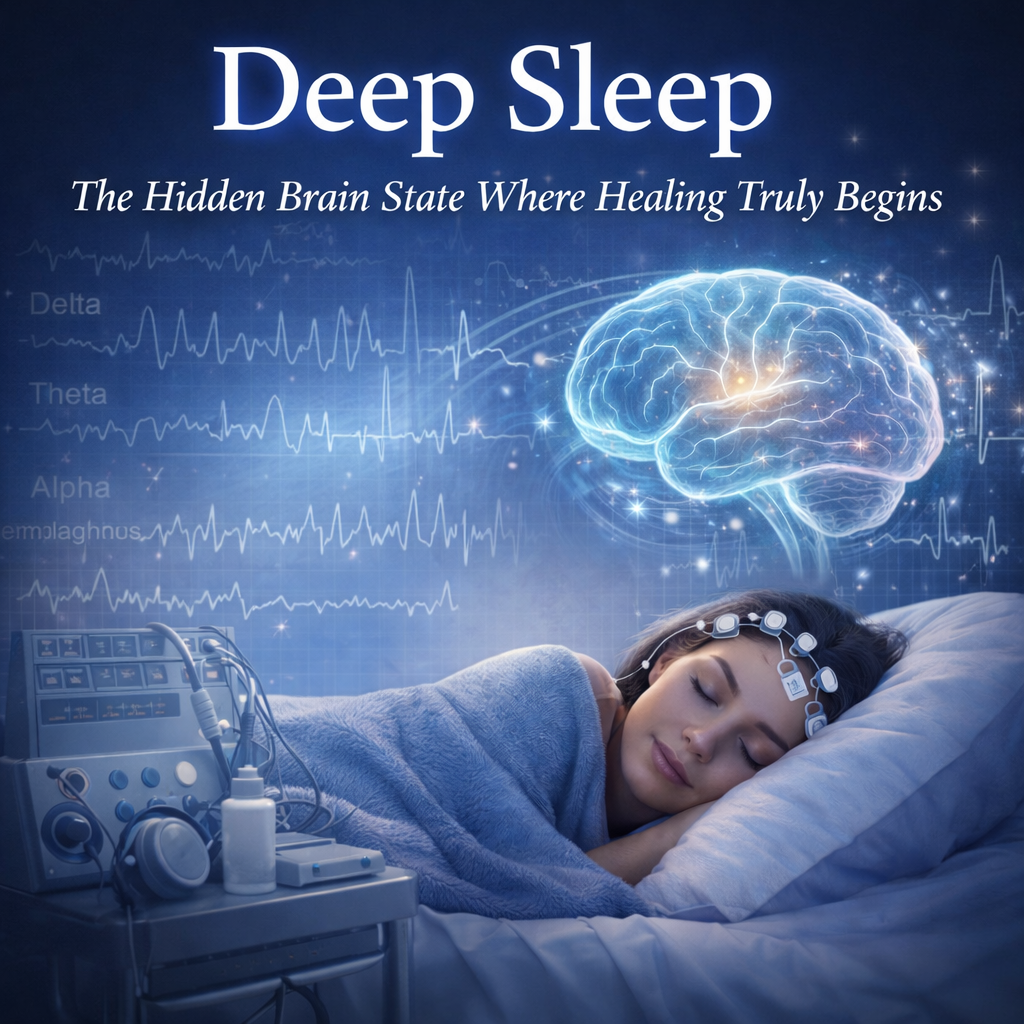
Recent research has highlighted something fascinating about what happens in the brain during the deepest stages of sleep. The findings reinforce something we often talk about when discussing nervous system regulation and healing: deep sleep is not simply unconscious rest.
It is a distinctly organized neurological state.
Understanding that state helps explain why so many people struggle with sleep when their nervous system has been under prolonged stress.
If you’re interested in the original coverage of the research, you can read it here
When the Brain Finds Its Own Rhythm
The study explored how brain waves and breathing rhythms interact throughout different stages of sleep.
During wakefulness and lighter sleep, brain activity tends to synchronize with the rhythm of breathing. The body and brain move in a coordinated pattern.
But during the deepest stage of non-REM sleep, known as slow-wave sleep, that synchronization begins to loosen.
The brain’s slow delta waves begin operating independently from the rhythm of breath. In other words, the brain transitions into a state that is internally guided rather than externally paced.
Researchers observed that respiration-brain coupling weakens significantly during deep sleep, suggesting the brain shifts toward internally organized neural activity while restoration processes take place. (Neuroscience News)
This distinction matters.
Deep sleep is not simply a quieter version of being awake. It is a different biological mode where the brain begins focusing on restoration, integration, and repair.
The Brain’s Nighttime Restoration
Slow-wave sleep is where some of the body’s most important healing processes occur.
During this stage, the brain and body begin:
• Repairing cells and restoring tissue
• Strengthening immune function
• Consolidating memories and learning
• Processing emotional experiences
• Activating the glymphatic system, which helps clear metabolic waste from the brain
Research increasingly shows that these deep sleep stages are tightly linked with memory consolidation and the movement of cerebrospinal fluid that helps clear waste from neural tissue. (EurekAlert!)
Once the brain reaches this stage, it begins operating according to its own internal rhythm. The nervous system no longer relies on signals like breathing patterns to guide it. Instead, the brain shifts into a deeper level of self-regulated restoration.
This helps explain something many people experience but don’t always understand: it is entirely possible to spend many hours in bed and still wake up exhausted if the brain never reaches this deeper state.
The Role of the Nervous System
When people struggle with sleep, the challenge often isn’t sleep itself.
The challenge is helping the nervous system feel safe enough to transition into it.
When the body has been living in prolonged stress, elevated cortisol, persistent alertness, emotional rumination, the system can remain in a protective state. Even when someone feels physically tired, the nervous system may still be scanning for threat.
In this state, the brain may hover in lighter stages of sleep without descending into the deeper architecture of slow-wave restoration.
This is where nervous system regulation becomes important.
Practices such as:
• slow breathing
• guided relaxation
• hypnosis and imagery
• clinical sound therapy
can help shift the body toward the parasympathetic nervous system, the branch responsible for rest, repair, and regulation.
These approaches do not force sleep.
Instead, they create the conditions where sleep can unfold naturally.
The Bridge Into Deep Sleep
Researchers have long observed that transitional states, the moments when we move from wakefulness toward sleep, involve shifts in brainwave activity.
The brain gradually moves from faster beta waves associated with active thinking toward slower alpha and theta rhythms, which reflect relaxation and inward focus.
These transitional states are delicate.
If the nervous system remains overstimulated, the brain can struggle to cross the threshold into deeper sleep.
This is where tools like hypnosis and clinical sound therapy can be particularly helpful.
Certain sound frequencies and tonal structures can help calm cognitive activity and support the brain’s transition into slower neural rhythms. Carefully structured sound environments may help stabilize breathing patterns, reduce stress arousal, and guide the nervous system toward the parasympathetic state where sleep becomes possible.
In this sense, sound acts less like a sedative and more like a regulation signal for the nervous system.
Once slow-wave sleep begins, however, the brain takes over.
Its internal rhythms guide the restorative work that follows.
A Gentle Reminder
One of the most reassuring things about modern sleep research is this:
The brain already knows how to heal.
It does not need to be controlled or forced.
What it often needs is simply the right environment and a nervous system that feels safe enough to release its vigilance to allow the deeper rhythms of restoration to emerge.
Clinical tools like hypnosis, breath regulation, and therapeutic sound can help support that transition.
But the real work of healing happens when the brain enters its deepest rhythms of sleep.That is where repair occurs.
That is where integration happens.
And very often, that is where the nervous system begins to find its way back to balance.